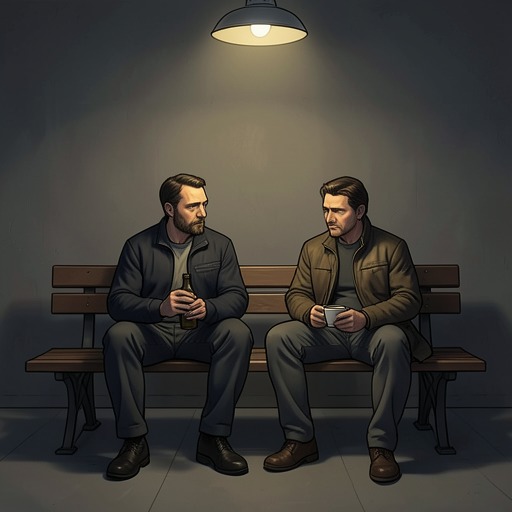
Patrick Henson’s homelessness
The Brass VerdictPatrick Henson’s homelessness is not an abstraction in the novel: it is a sleeping bag and a makeshift bed in a car parked in the garage where Jerry Vincent was shot. When Mickey Haller recognizes Henson asleep there, the encounter turns an earlier disclosure about living out of a car and sleeping in a lifeguard stand into an immediate practical concern. Haller responds with money and an offer of temporary shelter; Henson accepts the offer, though the evidence establishes the invitation and arrangements, not how long he ultimately stays.
Living in a car
Haller first sees Henson’s circumstances on a Thursday morning, after dropping his daughter at school and arriving early at Jerry Vincent’s law offices in the Legal Center. The garage is quiet enough that Haller can park on the second level near the office. He passes the spot where Jerry Vincent was shot, then notices a Subaru wagon with surfboard racks and a surfer sticker on its back window. The car’s tinted rear windows conceal its interior until Haller looks through the driver’s-side window.
Inside, the backseat has been folded flat. Open cardboard boxes filled with clothes and personal belongings occupy half of the rear space; the other half has become Henson’s bed. He lies asleep in a sleeping bag, his face turned away from the light. The arrangement makes the car both storage and shelter, leaving Henson’s belongings close beside the narrow place where he rests. His surfboard is part of this precarious mobile setup too: when Haller later gives him an address, he tells him to pick up the board before heading there.
The sight prompts Haller to recall what Henson had said during their first phone conversation, when Haller asked whether he wanted a job as a driver. Henson had disclosed that he was living in his car and sleeping in a lifeguard stand. The two details describe not a single fixed sleeping place but a sequence of improvised ones: the lifeguard stand from the earlier conversation, then the wagon in the Legal Center garage. The text gives no account of how long either arrangement has lasted.
The garage as a precarious shelter
Henson is asleep in a garage that is not merely a place to leave a car. It is the garage adjoining the Legal Center, and Haller has just passed the place where Jerry Vincent was shot to death. The danger is concrete enough to shape Haller’s response: when he speaks with Henson later, he apologizes for not remembering the disclosure and says he does not know how safe it is to sleep in the same garage where a man was shot the other night.
Haller had raised his fist to knock on the car window, then decided not to wake Henson because he would not need him until later that morning. The choice is a small one, but it distinguishes noticing Henson’s situation from treating him as an interruption. Haller lets him sleep; the eventual conversation takes place later, when Henson can answer for himself. Asked about being seen in the car, Henson responds that he will find another spot. His lowered gaze follows, without the narrative spelling out what he feels.
Haller’s offer
Haller takes responsibility for his lapse in memory rather than making Henson explain the circumstances again. He recalls both parts of the earlier disclosure—the car and the lifeguard stand—and shifts from concern about the garage to concrete options. He offers an advance on Henson’s pay, suggesting that it might help him get a motel room. Henson hesitates, then says he guesses it would help. Haller is glad to assist, while recognizing that a weekly motel could be nearly as depressing as living in a car.
Instead of stopping at the advance, Haller offers Henson a place in his own home for a couple of weeks, until Henson has some money and can make a better plan. Henson checks that the offer is actually to stay at Haller’s place, then accepts. The terms matter: the proposed stay is temporary, and Haller frames it as breathing room while Henson gets money together and considers what comes next, not as a permanent solution.
A practical transition
Haller writes his address on a Post-it that had been used for the liquidator’s address and gives Henson precise directions. Henson is to collect his board, go to the address on Fareholm near Laurel Canyon, climb the stairs to the front porch, and find the extra key under the ashtray. The guest bedroom is beside the kitchen, and Haller tells him to make himself at home. Henson thanks him and looks at the address.
These details turn the offer into an actionable plan: Henson is given a key, a room, and a sequence of steps for reaching them. Yet the boundary of what is established remains clear. Henson agrees to go, and Haller provides instructions; the scene does not confirm his arrival or establish the eventual duration of his stay. Homelessness in this episode is rendered through material arrangements—the folded seat, boxes, sleeping bag, board, and hidden key—and through the modest change Haller can offer: shelter now, with a little time to work out what comes next.